
My life with medical devices: from patient to designer
My life with Medical Devices, a personal and professional journey... For the last half of my career, I’ve been helping design and develop medical devices, from auto-injectors to diagnostic devices, surgical tools to breath trainers. But recently, I’ve been reflecting on something I’d never really said out loud: Medical devices haven’t just been my work, they’ve been my life. From the day I was born eight weeks early, my survival depended on them: a Gregory Box, blood bags, syringes and other devices that quite literally kept me alive. Since then, through childhood injections, hearing implants, and watching my own family rely on medical technologies, these devices have continued to shape who I am and how I see the world. So, over the next few months, I’m sharing a short series of reflections called “My Life with Medical Devices.” It’s a blend of personal story and professional insight, exploring how the tools that save and sustain us also teach us empathy, design thinking, and the real meaning of user experience.
When I was asked in my interview as part of joining OPD (Oxford Product Design) what medical device gets me out of bed in the morning, I gave the simple answer:
“No specific device, rather working on devices that improve people’s lives.”
And while that’s still true, I’ve since reflected and realised that my connection to medical devices runs far deeper, because they’ve been part of my life from the very beginning.
I started life depending on them, they’ve saved my life, they’ve changed my life, they’ve improved my life, and I still rely on them today.
And they’ve shaped not just my health, but my career and outlook on design.
Day One: Dependent on Devices
I was born in Dublin, eight weeks early, and I wasn’t a healthy baby. I had severe jaundice and ended up in what was known as a Gregory Box, an early, very unfriendly looking, neonatal CPAP system that kept my lungs open and my oxygen levels stable.
But that was just the beginning. Within days, I needed two full blood exchange transfusions to survive. The blood was stored in flexible PVC blood bags, which at the time represented cutting-edge technology. They saved my life.
Decades later, I discovered those same blood bags that had saved me were also likely responsible for the growth hormone deficiency that defined my childhood. Back then, they were made from PVC plastic softened with DEHP, a chemical that could leach into stored blood. We now know DEHP can interfere with the growth hormone and IGF-1 systems, particularly in premature infants.
It’s hard to imagine a clearer example of benefit–risk analysis in action. I’m alive today because of those bags and because of them, I also became who I am today.
Growing Up Small and Learning About Devices First-Hand
By around seven, it was clear I was much smaller than my classmates. Tests revealed my bone age was four years behind my actual age.
By sheer coincidence, my father met a paediatrician who specialised in growth disorders, and I was enrolled in a biosynthetic human growth hormone trial run by Eli Lilly.
That began my journey with drug delivery devices, the first step on a path that would later define my professional life.
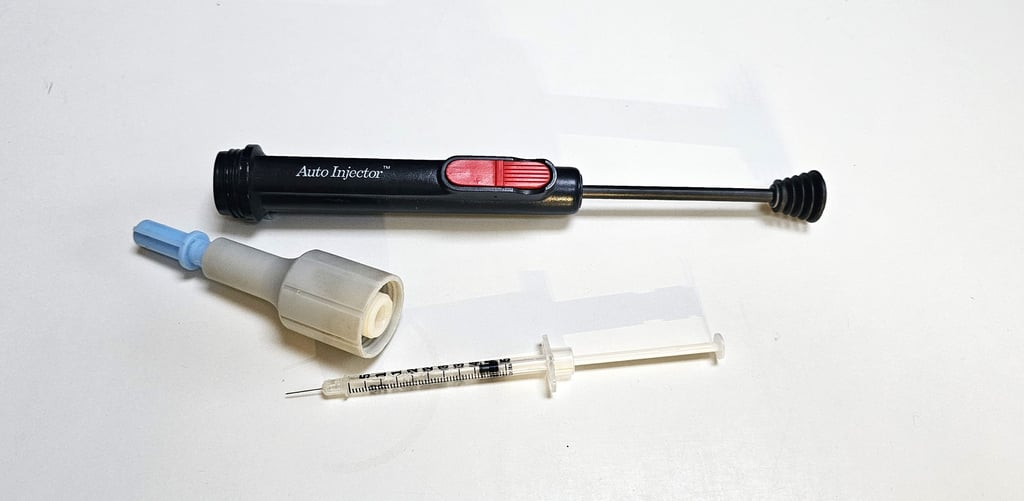
Initially, treatment involved vials and syringes, received in bulk, stored in the fridge and carried everywhere with letters explaining why I was travelling with needles. Then came an Owen Mumford auto-injector.
For the first time, I could inject myself. Every day.
The device made a reassuring click as it fired, but I never knew how it would feel. Sometimes there was no pain; other times, I’d hit a nerve and the sensation would shoot down and back up my leg in a flash.
Over time, I learned to rotate injection sites, alternating legs within a precise oval-shaped area. Even so, the repeated injections left small divots, permanent reminders of both my resilience and the impact of device design on the body.
That daily ritual taught me things I couldn’t have learned in any engineering lecture: what it means to trust a device, what pain unpredictability feels like, and how something designed to help you can also subtly shape your life.
A Lifelong Relationship with Medical Devices
Medical devices never really left my life. As an adult, I now wear an implanted BAHA hearing aid, which helps me hear clearly. My mother is currently undergoing treatment for leukaemia, at times surrounded by infusion pumps, cannulas, and medical devices that keep her alive. My father has had cardiac stents implanted, restoring blood flow and vitality.
Everywhere I look, from my own body to my family’s health, I see the work of the medical device industry, the fusion of science, compassion, and precision engineering that quietly sustains life.
That’s why I say I didn’t just choose to work in medical devices. In many ways, they chose me.
From Patient to Designer
When I joined the design world, I didn’t fully appreciate how much my past would inform my approach. But over time, I’ve realised that living with devices has given me something that no degree could: empathy.
I’ve been the patient pressing the button, not knowing whether it would hurt. I’ve been the child who had to explain a bag full of syringes and drug vials to friends. And I’ve been the adult reflecting on how one generation’s innovations can become the next generation’s lessons in biocompatibility and risk management.
Now, as someone leading teams developing medical devices, I carry that understanding into every project.
Closing Reflection
When I look back now, it’s easy to trace the thread:
A Gregory Box helped me breathe.
Two blood exchanges kept me alive.
Plasticizers in the blood bags may have stunted my growth.
An auto-injector helped me take control of my health.
A hearing implant helps me hear my children laugh.
For me, medical devices aren’t just tools. They’re touchpoints in a lifetime of human connection, design innovation, and scientific progress.So when people ask me what medical device gets me out of bed in the morning, I no longer hesitate.
It’s all of them, every single one that’s kept me, and others like me, alive and thriving.
The journey continues...
This article marks the beginning of a broader personal and professional reflection, a growing series that connects lived experience with the realities of medical device development.
In the months ahead, I’ll be exploring the many devices, systems, and moments that have shaped my life and career: from biocompatibility lessons rooted in my earliest days, to the design of drug-delivery systems and respiratory devices, to the human interface of hearing technology.
I’ll also reflect on experiences with clinical trials, patient pathways, and the emotional side of using and designing devices that people depend on every day.
These stories aren’t just about technology. They’re about connection, trust, and the role design plays in helping people live better, safer, and more confidently. And as the series unfolds, I hope it sparks conversation, empathy, and a deeper appreciation for the human journey behind every medical device.
All rights reserved © 2026
simon@collingsmedical.co.uk
Staines-Upon-Thames, UK
Collings Medical
Independent Medical Device Development Consultant